


Website:https://www.fujifilm.com/fb/
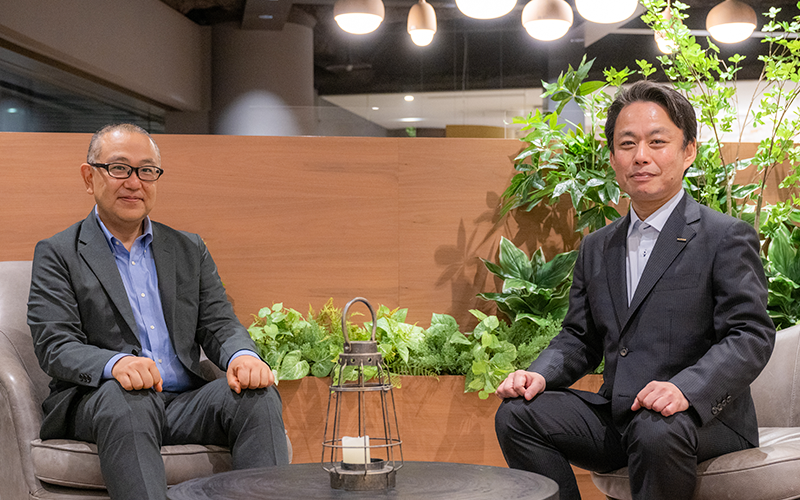
Thank you for your cooperation in the interview.
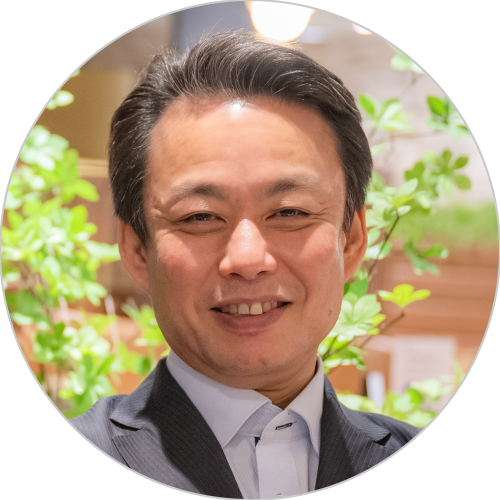
Fujifilm Business Innovation Co., Ltd.
Business Solution Service Division
Technology Development Group Leader
Mr. Yoshio Kikuchi
He has been involved in a wide range of manufacturing value chain activities, from research and development of multifunction printers and software products, technology development, and product development to working in overseas factories. In addition to research and development such as power supply design for multifunction printers, optical technology development for scanners and LED print heads, and image structure research for high-quality output, he has also served as the head of parts quality control at the Shenzhen factory and launched new businesses based on research themes.
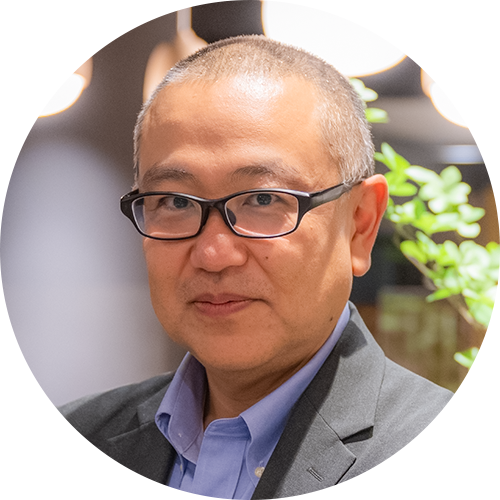
BIRD INITIATIVE株式会社 執⾏役員CDO 兼
NEC Corporation Data Science Research Laboratories
Senior Chief Researcher
Satoshi Morinaga
In the field of AI/data analysis technology, he has been involved in the planning, launch, principle/application research, commercialization, and social implementation of many new themes. He has also been involved in the design of new bank risk regulations and international standardization, the development and commercialization of text analysis technology and white-box prediction technology, and the launch of simulation x AI technology research at the NEC AIST AI Collaboration Research Center.
(Titles omitted below)
This time, we asked two leaders to share their thoughts on how companies should manage research and development, which requires a medium- to long-term period of time, amid major changes in society, the market, and the business environment: Kikuchi Masao, who has served as head of the research department at Fujifilm Business Innovation Co., Ltd., a global multifunction printer and solution service company, and currently leads the research and development organization in the solution services field; and Morinaga Satoshi, CDO of BIRD INITIATIVE Inc. (BIRD) and an expert in the field of AI/data analysis technology at NEC Corporation (NEC).
01As an engineer
First, please tell us about your careers so far.
Kikuchi:When I joined the company, I worked on power supply circuit design in the product development department. Later, because I was interested in the image quality of copiers, I was transferred to the development of scanner optical technology. At the time, there was interest in lead-free glass for environmental reasons, but improving performance without adding lead to increase the refractive index was a difficult challenge that required trial and error. Lens design requires finding a local solution from an evaluation function with a huge number of parameters, and I worked on applying functions to those local solutions, similar to today's machine learning algorithms. Later, to strengthen our production system in China, I worked at a group company in Shenzhen for about three years, overseeing quality control of parts delivered by local vendors. This gave me valuable experience leading both technical and management liaison between local companies, the field, and headquarters. After returning to Japan, I was expected to utilize my experience in production and development, and as director of the Marking Technology Research Institute and the System Technology Research Institute, I worked with a team of approximately 50-100 people to develop technologies for 3D printing and AI utilization.
Morinaga:I was assigned to the research lab when I joined the company, and was put in charge of fault-tolerant systems, just as the company was beginning to research them. This field involved mathematically expressing system reliability, and I studied the balance between system reliability and backup system redundancy using mathematical models. Later, when the government established the Financial Supervisory Agency (now the Financial Services Agency), it sought personnel skilled in financial engineering for system vendors, so I was seconded from the company. I initially expected to work in a technical field, but I was assigned to handle negotiations with various countries as an administrative officer, conducting international negotiations with representatives from various countries. Negotiating with people from a completely different culture and environment from NEC's own—a slightly different concept from what the private sector calls social implementation—was a valuable experience, learning the tough negotiations and collaboration required for implementation, even as a mere mathematician. Although the secondment itself lasted about a year and a half, I continued working at the FSA for the next eight years in a concurrent role. Since returning to NEC, I have been conducting research and development in areas centered on the construction and analysis of mathematical models, such as AI, data science, and big data, in collaboration with AIST and RIKEN.
02Corporate research and development
How do you feel about the changes in the social environment in recent years?
Kikuchi:I feel that the speed of social change is overwhelmingly rapid. Social change in China has been particularly intense. When I was posted to Shenzhen, several subway lines were built in a flash, with construction ongoing around the clock. I was particularly shocked by government decisions, such as the way existing buildings were transformed in the blink of an eye through Scrap & Build. When I first started working in China, I used cash at ATMs, but by the time I returned three years later, I was using electronic money. I witnessed the dramatic changes in society, both public and private. Meanwhile, when I returned to Japan, I found that nothing had changed since my posting in China, which created a huge gap. Even so, COVID-19, while a hard landing, has brought about rapid change in Japanese society. I believe that diverse and flexible working styles are now required.
Morinaga:As you say, the changes in China are enormous. I particularly feel China's momentum in the academic field. I've been attending AI-related conferences for 20 years, and while in the past, Western researchers were the main speakers, now the number of participants from China and India has increased dramatically. I've been very surprised to see that some well-known international conferences are sold out and I can't attend. Both countries are fast-paced in research and development, and the volume of work they do is large, so I feel that Japan's presence in the international community is declining. However, Japan has a long history of basic research, so I think it's necessary for Japan to find a way forward in these fields.
Are there any changes in your business environment?
Morinaga:In my own circle, expectations for AI and data science have changed dramatically. Before 2000, if you were researching machine learning or data analysis, people would ask you, "What are you doing playing around with?" However, with the big data boom of the 2000s, some researchers moved from hardware to analytical technology, and research trends changed dramatically. However, research in the field of AI has had its ups and downs, and although there have been two periods in the past when it has attracted attention from the public, it has not seen the light of day. It's a funny story now, but at the time, the word "AI" was also considered unlucky, so I even tried to avoid using it in the names of internal organizations. (Laughs)
Kikuchi:Most recently, in 2019, our company underwent a major change in capital structure, marking a new start as a wholly owned subsidiary of Fujifilm Holdings. Our internal structure and systems are also changing to enhance synergies within the group. Starting in July 2022, in order to further accelerate our solutions and services business, our research laboratories, which previously served as cost centers and handled everything from basic to applied research for the entire company, became part of the business division responsible for solutions and services. I myself am even more conscious of contributing to the business division I belong to. Until now, even if I wanted to commercialize a research topic, I needed to be accepted by another business division, but under the current structure, those barriers have been removed, making it easier to move forward quickly.
What do you think about the role of research and development in companies in the future?
Kikuchi:Naturally, corporate R&D is expected to contribute to the company's sales and profits with new technologies and new value. It is necessary to contribute to existing businesses, but I also think it is important to strike a balance by looking ahead and setting new research themes.
Morinaga:As Mr. Kikuchi said, it's important to maintain an overall balance while continuing to pursue themes. As I mentioned earlier, NEC began research into AI and machine learning, but in the 1990s, progress in social implementation was slow, and competitors withdrew from research and development. Despite this, NEC persevered and continued its research, and although one could say that it simply "left behind" (laughs), it is now at the forefront of fields such as image recognition, machine learning, AI, and quantum computing. I believe that it is necessary to address not only immediate themes, but also fields that are expected to grow in the medium to long term.
Kikuchi:That's right. To achieve this, I think it's extremely important to have an "eye for quality." I feel that R&D management is not just about having an eye for technology, but also about being able to grasp changes in the world.
Morinaga:Certainly, the ability to judge is extremely important. At the same time, I feel that in this rapidly changing world, it is becoming increasingly difficult to see into the future. Portfolio management is now commonly touted in a variety of situations, but it was originally a management method used to hedge the risks of various highly volatile financial products. In today's social and business environments, where uncertainty is on the rise, I believe that it is becoming extremely important for companies to manage their portfolios in a fundamental sense, even when it comes to their research and development themes.
What challenges must you overcome to develop a new business?
Morinaga:There are two ways to create a business from research and development. The first is to provide new value through research into an existing market. The second is to develop a new market that has never existed before. The challenge with existing markets was that we were unable to utilize sales channels to quickly introduce products. On the other hand, with new markets, there were very few people with the capabilities to begin with. I think there were only a handful of people in a group of 100,000 people. A methodology has finally been established within the company, but up until then it was just individual play and could not be called an organized activity.
Kikuchi:When it comes to creating new businesses, I believe that past successes can sometimes act as a drag. This is what's known as the innovation dilemma. In order to minimize the impact on existing businesses, companies fear failure or are impatient to wait for success, leading to past successes acting as a hindrance. I believe that an optimal system that prevents failure and a system that allows companies to quickly pioneer new things are completely different. Evaluating business viability is also an issue. If the period of successful experiences is long, the evaluation method will tend to be aligned with existing businesses and may not be appropriate for new businesses. 1 million yen in sales from an existing business and 1 million yen in sales from a new business will have completely different meanings when calculated in net present value based on market growth rates. While the figures are listed as the same, I believe that business viability must be viewed with future growth in mind.
03Technology Development Management
What will be required of technology development management in the future?
Kikuchi:Looking back at past technological developments, there have been cases where business planning took precedence and technological development was unable to keep up, or conversely, technological development took precedence and before we knew it, we found ourselves far removed from market needs, so we ended up back at square one. This was not a very good approach. In recent years, social issues have become increasingly complex, and I feel that they cannot be solved by a single company alone, and that business development must involve a variety of combinations of technology and partners. In that sense, it is important to take a bird's-eye view of technological development as a whole,Both technology and business must be developed in parallelI think so.
Morinaga:This is exactly what we are talking about: management based on BRL-TRL assessment, one of the BIIMs that our company offers.
Kikuchi:That's right. It made me realize how important it is to not only monitor the status of conventional technological development, but also to simultaneously grasp the progress of commercialization. In particular, the business development process was something that the R&D department had not previously had, so it was very helpful. Also, when actually proceeding with business development, the positioning of activities can change significantly depending on customer needs and the status of technological development, but because the situation is visualized, it has become possible for practitioners and management to share a common understanding, which has also made communication smoother.
Morinaga:NEC has finally put in place a business development process, and new business ventures are now being developed with a common understanding of how to proceed. Furthermore, while still experimental, we have begun an initiative to advance business development activities in parallel at each stage of basic, applied, and implementation for research themes in new fields. Previously, in the linear model of basic research, applied research, and commercialization, it sometimes took around 10 years to verify and determine the marketability of a new business, but now, ascertaining customer needs from the early stages of research has become a standard at Gate. Both research and development and business development require solving various issues, so while it can be difficult, I believe it is the right thing to do to move forward despite the uncertainty.
What about the awareness of researchers themselves going forward?
Kikuchi:In my New Year's greetings and other occasions, I tell my team members that three things are important. The first is "spare no effort to improve society," the second is "move forward quickly while making minor adjustments to plans," and the third is "respect diversity and incorporate diverse opinions to improve things." While business viability is important, I believe it's more important to have a clear image of what it would be like to achieve rather than calculating the money. For example, sometimes researchers bring up research topics that I can't understand. Even if I don't understand what they're saying at first, I try to understand by repeatedly changing the way I listen. If they're explaining things carefully, I assume there must be something there, so I try to give them a try. Sometimes it ends up being a failure, but I want to cherish the energy and passion of researchers.
Morinaga:This is a very embarrassing story, but... although NEC's white-box data analysis is now socially recognized, when my subordinate first proposed it as a research topic at the time, I rejected it as a technically impossible technology. Still, when the researchers finally managed to put it into practice, I was shocked, and ever since, I've begun to doubt my own ability to judge. At the time, I prided myself on being an expert in this field, so I thought that something that made possible something I thought was impossible would truly shock the world. There are two types of reasons why people say "you should give up" on a research topic. One is, "It's boring to try," and the other is, "There's no way it can be done." After this incident, even when the answer is "There's no way it can be done," I started to say, "Let's give it a try."
Kikuchi:I'm also someone who doesn't give up easily, so even if management tells me to stop many times, there are some things I just can't give up on. It might be hard for my subordinates to prepare the materials, though (laughs). Sometimes I think that this technology would be amazing if it could be released to the world. I don't want to give up on things that I truly believe in. And one more thing: as I've said before, today's society requires collaboration with other partners to solve problems that cannot be solved by a single company alone, so I want engineers to interact with a variety of people. Up until now, I've had interactions with other researchers, but I've had few opportunities to have sessions with business development professionals, so working with BIRD was a very refreshing experience.
Morinaga:As is the case at NEC, there are many unique and charming researchers. (Laughs) We had lively discussions during our work with your company, and I felt that there were many very passionate engineers and a strong desire to move things forward. In many work sessions around the world, a lack of depth in the discussions can often be an issue, but I think the BIRD consultants facilitated the session well. I'm a little biased, though (Laughs).
Kikuchi:After all, if we send out people who can't express what they think, no chemical reaction will occur. We sent people from within the company who can clearly express what they think to the program with BIRD. Morinaga's use of the word "charming" is new (laughs).
04At the end of the technical discussion
Finally, what is the appeal of BIRD?
Kikuchi:BIRD's appeal lies in its diversity and professionalism. In particular, in the field of business design, Kitase-san and others have a proven track record with major companies, making them a very reliable partner. They also understand the circumstances of large corporations. I have worked with a variety of venture companies in the past, and there are certainly some cultural differences. Even in cases where it would be difficult for a venture company to understand, such as how best to approach internal decision-makers or the speed of decision-making, BIRD provided accurate advice. I think that combining the agility of a venture company with an understanding of large corporations is a strength that other companies do not have.
Morinaga:Thank you. BIRD has strengthened its management structure from October 2022, so we hope to be of even greater service to you.
Company Profile
Company name
Fujifilm Business Innovation Co., Ltd.
location
9-7-3 Akasaka, Minato-ku, Tokyo 107-0052
President and CEO
Naoki Hama
Establishment
February 20, 1962
Capital
20 billion yen
Business Content
We operate three businesses globally: the office solutions business, which focuses on multifunction devices and printers; the graphic communications business, which provides printing workflow solutions from digital printing machines in the commercial printing field; and the business solutions business, which provides problem-solving document services for various business issues.
Website
https://www.fujifilm.com/fb/
Comment